
By Teigan Goldsmith Hitsman
The High Holidays are an incredibly busy time for the best of us.
There are meals to prepare, relatives to coordinate, services to attend, seats to reserve, and the annual realization that somehow Rosh Hashanah has arrived before we finished everything on our to-do list. For many, the High Holiday season can feel like a carefully choreographed sprint from one commitment to another.
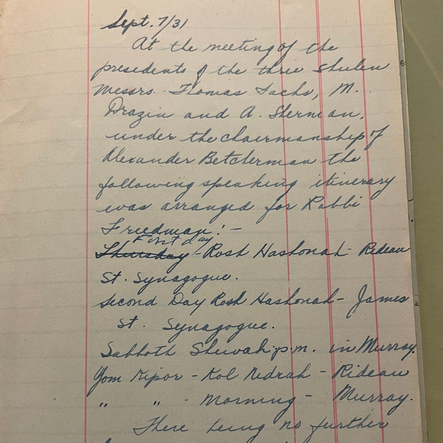
But in 1931, an Ottawa Rabbi may have had all of us beat. Rabbi Rev. Abraham H. Freedman, who had been hired by the Associated Synagogues of Ottawa committee earlier that year, served three of Ottawa’s congregations. This number would change to four congregations two years later with the addition of the King Edward Street shul.
In 1931, Rabbi Freedman experienced his first year serving three of Ottawa’s congregations and his High Holiday calendar was not for the faint of heart.
On the first day of Rosh Hashanah, Rabbi Freedman was at the Rideau Street synagogue. No time to settle into one location for long, however: on the second day of Rosh Hashanah, he was scheduled to lead services at the James Street Shul. Then came Shabbat Shuvah, the Shabbat between Rosh Hashanah and Yom Kippur, when Rabbi Freedman was at the Murray Street synagogue for the evening service. And, naturally, the schedule only became more complicated from there. For Kol Nidre, Rabbi Freedman returned to the Rideau Street synagogue. By the following morning, for Yom Kippur services, he was at the Murray Street synagogue.
At this time, the Rideau Street synagogue and Murray Street shul were only a 12-minute walk from each other, but the James Street shul, which had been established to serve those who lived outside of the downtown core, was a 45 minute walk away. Thankfully, it looks like they took that into account and his only visit to the James Street shul was on the second day of Rosh Hashanah.
Rabbi Freedman’s 1931 schedule tells us something important about Ottawa’s Jewish community at the time. By the early 1930s, several congregations were serving the city’s growing Jewish population and due to financial challenges during the Great Depression, Ottawa’s congregations had to explore new ways of sharing rabbinical leadership and resources. In the face of adversity, our community always finds a way to make things work and look out for the greater Jewish community.
So, as we rush through another High Holiday season and wonder how we are possibly going to fit everything into the next few weeks, perhaps we can take some comfort in knowing that for more than a century, Ottawa’s Jewish community has always been busy during the High Holidays and that no matter the challenge, we’ll find a solution.
Although, thankfully, most of us only have to get to one synagogue at a time.
-- Teigan Goldsmith Hitsman is the Archivist at the Ottawa Jewish Archives.