
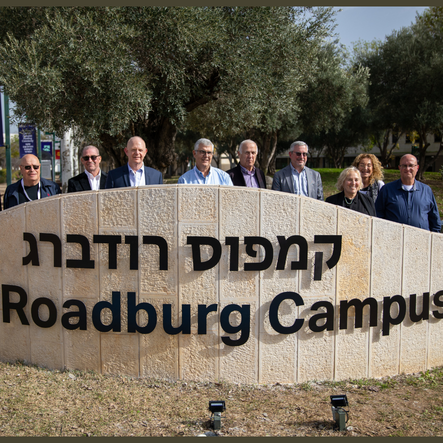
The Ronald S. Roadburg Foundation has announced a historic $50 million donation to Tel Hai University, marking one of the largest philanthropic investments ever made in Israel’s Galilee Panhandle.
For Ottawa’s Jewish community, this investment carries particular significance. The Galilee Panhandle, known in Hebrew as Etzbah HaGalil, is Jewish Federation of Ottawa’s long-standing partnership region in northern Israel. Through Partnership2Gether’s Coast-to-Coast initiative, Ottawa has built deep relationships across five municipalities in the region, supporting local leadership, education, and community resilience. Tel Hai University serves as a central academic and economic anchor in that same region.
Founded in 2021 through the estate of the late Vancouver businessman Ronald Roadburg z”l, the foundation works to strengthen and secure Jewish and other at-risk communities, support populations disproportionately affected by inequities, and respond to urgent challenges such as the climate crisis and addictions.
Many members of the foundation’s leadership have long been involved with Jewish Federations across Canada, including through Partnership2Gether’s Coast-to-Coast relationship with Etzbah HaGalil. That history helped inform their decision to focus their Israel philanthropy on a region they know well and where the need is especially urgent.
Adam Silver, President and CEO of the Jewish Federation of Ottawa, said “the love, attention, and generosity given to our partnership region spans decades, and the Roadburg Foundation’s incredible leadership, especially at this time, will yield benefit for decades more. There will be a huge ripple effect in Etzba Hagalil with Tel Hai University’s growth, one that will retain and attract residents, and will drive economic and cultural development.”
Their gift comes at a pivotal moment for Tel Hai, as it formally transitions from an academic college to a fully accredited university. This shift carries significant implications not only for higher education, but also for regional recovery, economic development, and long-term resilience in Israel’s north.
“This investment didn’t emerge in a vacuum,” said Mark Gurvis, CEO of the Ronald S. Roadburg Foundation. “It builds directly on more than 25 years of Canadian Jewish communal engagement in the Galilee. We’re proud to be part of that continuum and to help take it to a new level.”
The $50 million commitment includes a previously announced $8 million contribution toward the construction of a new computer sciences building, now incorporated into the larger gift. The funding will be deployed in phases, with approximately half allocated over the next several years and the remainder assessed collaboratively with Tel Hai leadership as the university continues to grow.
The donation will support construction of additional academic buildings, including a new laboratory sciences facility serving multiple faculties and a social work and therapies building in the heart of Kiryat Shmona. The latter represents an important step toward further integrating the university into the life of the city.
The funds will also establish new faculty positions, support the creation of an institute focused on “regionality,” and strengthen administrative and marketing capacity.
As a university, Tel Hai will now be able to expand research activity, recruit internationally, and offer doctoral-level programs, capabilities reserved in Israel for fully accredited universities.
Regionality, a key focus of the foundation’s investment, reflects a growing recognition in Israel of the need for stronger intermediary governance structures between municipalities and the national government. In Etzbah HaGalil, regional clusters increasingly collaborate on shared services, economic planning, and advocacy. Tel Hai’s leadership and research capacity position it as a natural hub for advancing this work.
The impact of the investment is expected to extend far beyond the campus. Tel Hai is already the largest employer and economic driver in the region and is projected to grow from approximately 5,000 to 8,000 students. That growth will attract faculty, researchers, students, and families, many from outside the region, creating demand for housing, education, services, and local employment across the Galilee.
The timing is especially significant. In the wake of the war, northern border communities experienced prolonged evacuations and slower returns, compounded by ongoing security uncertainty. With tens of thousands displaced and many younger residents hesitant to return, the region is at a critical juncture.
“When we looked at where philanthropy could truly change the trajectory of the north, Tel Hai stood out,” Gurvis said. “It’s not the only need, but it is a game-changing investment.”
The Ronald S. Roadburg Foundation’s gift represents both a bold philanthropic commitment and a reaffirmation of collective responsibility. For communities like Ottawa that have invested in long-term partnership with Israel’s north, it signals renewed confidence in the region’s future and in the power of education to anchor recovery, growth, and hope.
“Our relationship is derivative of the fact that the Canadian Jewish community has been, in a unified way, focused there for a long time,” said Gurvis. “We're proud and pleased to be part of that picture.”