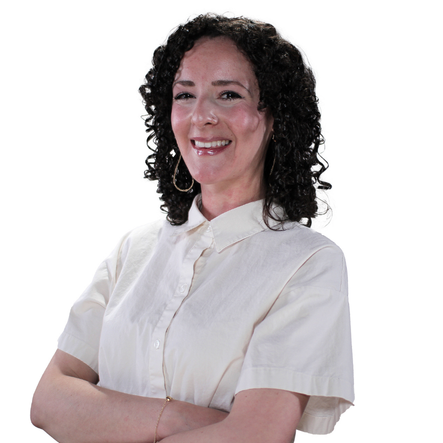
As we transition from Jewish Heritage Month to Indigenous History Month, the Ottawa Jewish E-Bulletin recently connected with Magnolia Perron, Director of Strategy and Partnerships at the National Aboriginal Capital Corporations Association (NACCA), about her Jewish and Mohawk heritage, as well as how these two identities intersect in her day-to-day life.
E-Bulletin: How do you blend your Jewish and Indigenous identities in your day-to-day life?
Perron: It can shift depending on the space I’m in, but at my core, I am a reflection of both identities. I am shaped by different parts of who I am, and my family’s history has influenced who I am from when I was a child all the way through to adulthood.
In my professional life, since I work for a national Indigenous organization, I show up with my Mohawk identity more. In Indigenous communities and cultures, it is very important that we position ourselves in terms of where we’re from, who our family is, and what our lineage is. As we meet with other communities and nations across the country or even globally, this helps them understand how they’re connected to us and are connected to our work.
Personally, the values I hold today have been shaped by my combination of identities, both through my Indigenous ancestry and my Jewish ancestry.
E-Bulletin: How were each of your cultures represented in your home when you were growing up?
Perron: I’m Mohawk and French Canadian on my dad’s side, and I’m Ashkenazi Jewish on my mom’s side. When my parents got married and decided they wanted to start a family, they made the decision to move to the Tyendinaga Mohawk Territory between Belleville and Kingston, Ont.
While my dad didn’t grow up on the reserve, my parents wanted us to have that connection to our Mohawk heritage and grow up around other Mohawk children. At the same time, with my mom being Jewish, although she wasn’t religious, we certainly were raised culturally Jewish. In many ways, my home was a place where both worlds coexisted – sometimes separately but always shaping how we saw ourselves.
My two older brothers had bar mitzvahs, so we attended a synagogue briefly while they were preparing for that. With the closest city to us being Belleville, which doesn’t have a large Jewish population, the rabbi would drive up from Toronto every week.
Even though we were a bit more disconnected from Judaism, it is still a big part of my identity. My parents really emphasized that we are part of both the Jewish and Mohawk cultures. When I moved to Ottawa for school, my grandfather encouraged me to connect more with the Jewish community here, which I did and from whom I’ve learned so much.
E-Bulletin: Since both Jews and Indigenous communities have experienced so much hardship over the course of our histories, would you be able to speak about the patterns on resilience and cultural preservation that you have experienced in both communities?
Perron: There are certainly many commonalities in the hardships and realities our communities have faced and continue to face. In both Jewish and Indigenous communities, resilience is not just about survival, but about maintaining culture, connection, and a strong sense of identity across generations.
For Jewish people, even though we are spread all over the world, there is a remarkable sense of connection. You can be in another country, meet someone for the first time, and quickly realize there are only a few degrees of separation between you. That sense of closeness and shared understanding is powerful.
I’ve experienced something very similar in Indigenous communities. Through my work across Canada, I can be in a completely different region and still find meaningful connections — whether through family, community ties, or shared experiences. Despite geographic distance, there is a deep sense of relationality and responsibility to one another. In both communities, that interconnectedness creates a strong foundation of care. We look out for one another, we uplift each other, and we carry a shared responsibility to preserve our cultures and support future generations. That sense of collective strength is something I’ve come to deeply value and carry with me in all aspects of my life.
To learn more about Indigenous history and culture, Perron recommends the following resources:
Documentaries:
• Club Native
• Kanehsatake: 270 Years of Resistance
Books:
Adults
• The Reconciliation Manifesto: Recovering the Land and Rebuilding the Economy by Arthur Manual and Grand Chief Ronald Derrickson
• The Inconvenient Indian: A Curious Account of Native People in North America by Thomas King
• 21 Things You May Not Know About the Indian Act: Helping Canadians Make Reconciliation with Indigenous Peoples a Reality by Bob Joseph
• The River is in Us by Elizabeth Hoover
• Seven Fallen Feathers: Racism, Death, and Hard Truths in a Northern City by Tanya Talaga
• Grounded Authority: The Algonquins of Barriere Lake Against the State by Shiri Pasternak
• The Break by Katherena Vermette
Kids
• Nibi’s Water Song and Smile So Big by Sunshine Tenasco
• Together We Drum, Our Hearts Beat as One by Willie Poll
Shop Indigenous (Local):
• Beandigen Café
• ADAAWE Indigenous Business Hub
• The Canadian Council for Aboriginal Business has a Certified Aboriginal Business program so you can always check their directory for businesses.
Speakers:
If you are looking for speakers, you can contact the International Indigenous Speakers Bureau for assistance.
Upcoming Events:
• Summer Indigenous Art Market (Sunday, June 7, 2026)
• Summer Solstice Indigenous Festival (Saturday, June 20, 2026)