
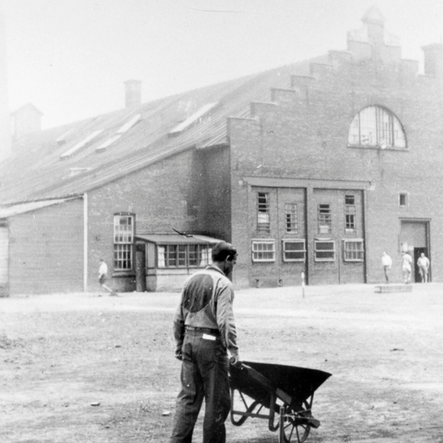
When Jewish refugees fled Nazi Germany for the United Kingdom in the late 1930s, many believed they had escaped certain persecution. Few could have imagined that their search for safety would end behind barbed wire at internment camps in Ontario, Quebec, and New Brunswick, where they were labelled not as refugees, but as “enemy aliens.”
Today, as fewer of those internees remain alive to share their stories, the responsibility has passed to their descendants. They are now carrying this history forward and calling on the Canadian government for formal recognition and an official apology.
Nearly 2,400 Jewish refugees were interned upon their arrival in Canada. Among them was Rabbi Rudolph J. Adler z”l (pictured at right).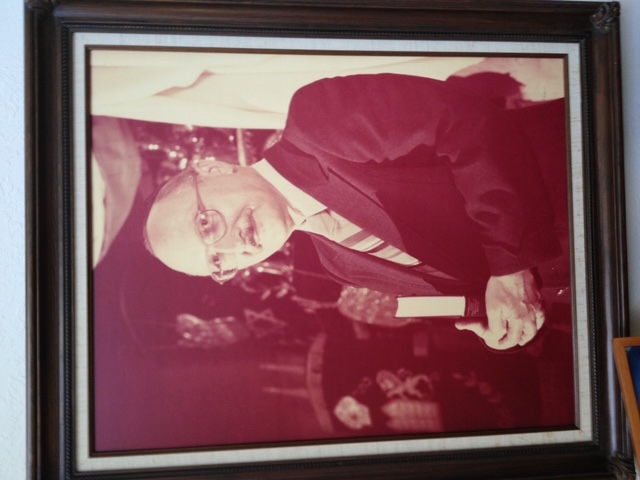
A yeshiva student when the Nazis came to power, he witnessed Kristallnacht firsthand, seeing synagogues burned and Jewish lives destroyed. Recognizing the danger, the head of his yeshiva arranged for students to flee Germany. That foresight saved his and his classmates’ lives.
Adler was sent to Liverpool, England, where he completed his rabbinic ordination at just 20 years old. In 1940, fearing a German invasion, the British government deported thousands of German nationals without distinguishing between Jews fleeing the Nazis and those who supported them. Shipped overseas, Adler arrived in Canada as a civilian internee.
His son, Paul Adler, believes his father’s story and those of his fellow internees need to be brought to light. That’s why he, and other descendants of internees, have launched a petition to the Canadian government to recognize and apologize for the mistreatment of Jewish refugees who were forced to live in squalor upon their arrival to Canada.
“I think it’s important for all of us to stand up and communicate as best we can to our friends, families, and the rest of the community that this was a serious event in the lives of our parents,” he said. “Not only did it impact them and us, but it also affected the whole world to some extent because so many people who experienced these situations … went on later to become successes and made positive impacts around the world.”
Quoting his father’s autobiography and diaries, Adler shared the horrors his father faced in Canada and the conditions that he and many other Jews were forced to experience upon their arrival.
“They worked, studied, and prayed, but were … confined behind barbed wire,” he said.
Ian Darragh, a journalist and historian who is helping spearhead the petition, added that “the Canadian government has already apologized for the internment of Italian, Ukrainian, and Japanese Canadians, so in all fairness, this is the last apology for internment that is required, and I think it’s only fair.”
But what will this recognition and apology accomplish?
Darragh hopes it will lead to greater educational opportunities for students across Quebec and bordering provinces to visit the ruins of the old internment camps, and suggested turning the old, abandoned train tracks that were used to shuttle Jewish internees to the different sites into a historical walk.
“I think what the families are looking for is acknowledgement about what happened,” he said. “We would like to have historical plaques set up at the nine internment camp sites and then funding for educational programs that combat antisemitism.”
Adler added, “the time has come for the rest of the world to know about this because we’re not going to be around for many more years.”
The official House of Commons e-petition is open for signatures from Canadian residents until February 28 at 11:44 a.m. ET. Since the petition has already received more than 500 signatures, it will be tabled in the House of Commons, and the Government of Canada is required to respond. You can read and sign it by clicking here.