
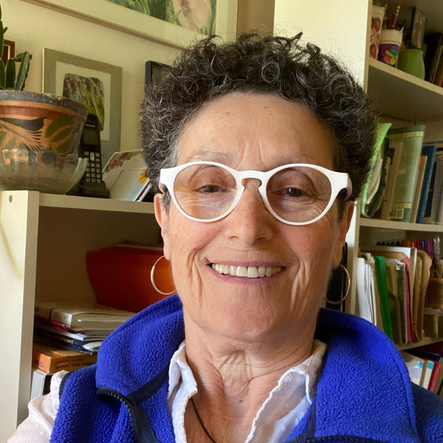
VOICES: For more than 30 years, Sabina Wasserlauf has been a thoughtful and dedicated leader within Ottawa's Jewish community. From serving on the boards of the Ottawa Jewish Community Foundation and the Soloway JCC, chairing the board of the Ottawa Jewish Community School, to supporting countless community initiatives, she has consistently demonstrated a deep commitment to Jewish life, learning, and engagement.
That same commitment extends to her relationship with Israel. This spring, Wasserlauf attended the JSpace conference, Shaping the Israel We Want. In this Voices feature, she reflects on her lifelong connection to Israel, why she believes supporting Israel and advocating for peace go hand in hand, and why creating space for diverse conversations remains important for the Jewish community.
-
For Sabina Wasserlauf, attending the JSpace Spring Conference this April was an act of hope.
The conference, titled Shaping the Israel We Want, in addition to J Space, was organized by the New Israel Fund of Canada, Canadian Friends of Peace Now, and Meretz Canada, and brought together activists, former parliamentarians, and community members from Canada, Britain, the United States, and Israel and was held at the Soloway JCC.
Its subtitle, Pro-Israel, Pro-Peace, Pro-Democracy, captured precisely what drew Wasserlauf through the doors.
"Those three statements are an essential part of my involvement with anything I do with regard to Israel," she explained. "It is promoting Israel, it is promoting peace, and it's promoting democracy in Israel within the framework of a two-state solution."
For Wasserlauf, those values are deeply personal, rooted in a life story that stretches across continents and generations. Born in Poland, her family had originally planned to emigrate to Israel before ultimately settling in Canada. Her mother's sister had made aliyah, and a rich network of relatives and friends in Israel meant she grew up with a close, lived connection to the country. She later spent a year studying at Hebrew University, deepening her attachment to the land and its people.
That attachment, she is clear to emphasize, is not ideological posturing from a safe distance. It comes with genuine care for Israel's future, including an honest reckoning with its challenges.
"It's not a question of the existence of Israel or the validity of Israel for me," she said. "It's very much to do with the politics." She described her position as fundamentally pro-Israel, precisely because she believes a lasting peace and a functioning democracy are essential to the country's long-term integrity and survival.
She and her husband have been involved in organizations like the New Israel Fund and Canadian Friends of Peace Now, and recently established a fund with the Ottawa Jewish Community Foundation specifically in support of Israeli-Palestinian alliances.
What made the J Space conference meaningful, she said, was hearing directly from people doing the hard, daily work of advocacy. She heard from activists meeting with members of parliament, building coalitions across social justice groups, and pursuing diplomatic pathways toward a peaceful resolution to the conflict. Speakers included the head of Peace Now and a former member of the Israeli Knesset.
"To hear what knowledgeable people are saying from across the world, people who have a lot of skin in the game, and to hear them say here's where it's hopeful, here are the visions we have," she reflected. "That's where the light is for me."
She is candid that hope, in the current moment, requires effort. "Someone said the other day, ‘pessimism is a luxury and hope is a discipline,’" she recalled. "It doesn't come naturally. You have to reach for it."
Wasserlauf believes the conference carries particular significance for Ottawa's Jewish community. Events that create space for a broader conversation send a message to community members who may feel isolated in their views.
"There are a lot of people who are feeling alone or in a minority who are hoping for a democratic state, for peace, and for some sort of resolution," she said. "For those people, what I value about an event like this is that it exists, that there are other people saying, yes, this is sane, this is moral, this is hopeful."
She wants the wider Jewish community to know the conference happened. Not to provoke, but to signal that the conversation is alive, that it is being held in good faith, and that supporting Israel and advocating for peace are not opposing impulses. They are, for many, exactly the same thing.
"It may not happen in my lifetime," she said. "It's still what I stand for, what I seek, and what I wish to support and pursue."